
FOMC Releases Updated Projections at March 2026 Meeting
The Federal Open Market Committee [FOMC] met this week to discuss economic developments and chart a course for monetary policy. The meeting didn’t bring a change to interest rates, but it provided an opportunity for the committee to release updated economic projections.
The FOMC’s forecasts are an important tool used by economists, business leaders, and bankers to inform their own predictions. The updated projections arrived at a time of increased geopolitical tension and reflected the uncertainty that the current conflict creates. This increased uncertainty was evident in the forecasts and language used to describe inflation, unemployment, interest rates, and economic growth.
FOMC Holds Interest Rates Steady
The committee voted to maintain the Fed Funds Rate at a target range of 3.50 – 3.75%. The current target range represents a “neutral stance” according to Federal Reserve Chairman Jerome Powell – meaning it is designed neither to accommodate nor restrict economic expansion.
The committee’s interest rate decision was well-telegraphed and agrees with the FOMC’s previous projections, so it came as no surprise to most economists. In fact, CME FedWatch showed over a 98% probability of no change to the Fed Funds Rate prior to the meeting.
Updated Economic Projections Show Little Change from Prior Forecasts
During the question-and-answer portion of the press conference, Chair Powell quipped that “if we were ever going to skip an S.E.P. [Summary of Economic Projections], this would be a good one.” This quote perfectly summarizes the sentiment around the conflict in the Middle East and the potential for an “energy shock” that could stem from it. Powell repeatedly said, “We [the FOMC] just don’t know” what will happen in the future, and different outcomes for the conflict could lead to vastly different outcomes for the economy.
Despite the uncertainty, each member of the committee submitted expectations for employment, inflation, interest rates, and GDP. A summary of these projections was released following the meeting and showed only minor changes from the prior estimates in December.
GDP Projections Increased Moderately
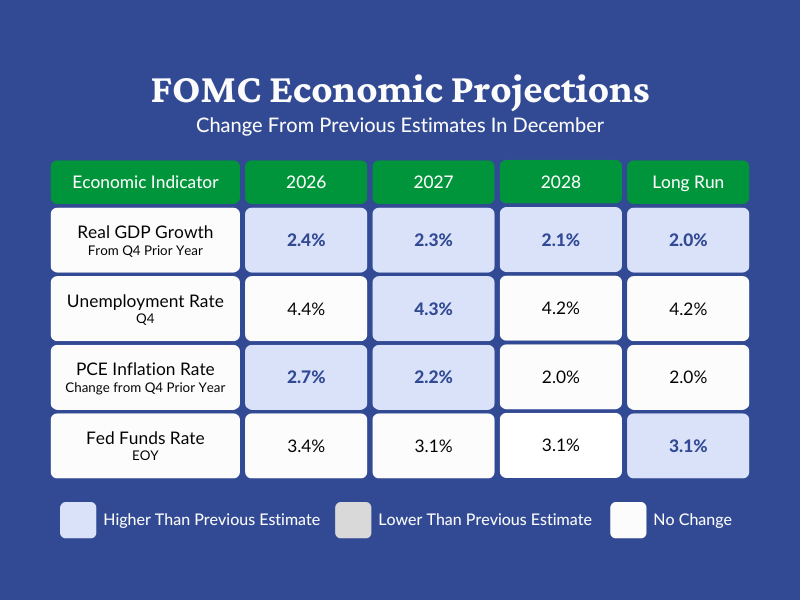
The projections for economic growth, represented by Gross Domestic Product [GDP], were the most dramatically changed figures in the updated projections. The committee raised their 2026 GDP forecast from 2.3% to 2.4% (+0.1), and the 2027 projection was increased from 2.0% to 2.3% (+0.3). The committee also raised their 2028 GDP forecast from 1.9% to 2.1% (+0.2). They set their long-run forecast to 2.0% – an increase from the previous projection of 1.8%.
In the press conference following the interest rate announcement, Chair Powell noted that economic growth has continued to expand at a solid pace since the committee last met. He offered resilience in consumer spending and expansion in business fixed investment as evidence of this claim. However, he also mentioned that activity in the housing market remains subdued.
The Bureau of Economic Analysis [BEA] showed that real GDP rose by just 0.7% in the 4th quarter after a downward revision from the initial estimate of 1.4%. The BEA report also indicates that the government shutdown in the 4th quarter had a negative impact on GDP, which the BEA estimates caused real GDP to be about 1% lower than it would have been without the pause. Given this information, the updated forecast for 2026 shows that GDP is expected to improve substantially from the 4th quarter’s rate.
Inflation Expectations Modestly Increased for 2026
The expectations for the PCE inflation rate in 2026 were raised from 2.4% in the December projections to 2.7% (+0.3) in the current forecasts. Future year expectations showed little change, with the forecast for 2027 increasing from 2.1% to 2.2% (+0.1) and the 2028 forecast holding steady at 2.0%. The long-run projection also remained stable at the Fed’s target of 2.0%.
In the press conference, Chair Powell noted that inflation has shown significant improvement since the highs witnessed in 2022 but remains elevated compared to the Fed’s 2% target. The Consumer Price Index [CPI] supports this interpretation, and it showed that prices rose by 2.4% from February 2025 to the same month in 2026.
Powell suggested that tariffs are responsible for much of the continued escalation in prices. In particular, he noted that goods prices – which are sensitive to tariffs – have trended well above their long-run average since the tariffs were introduced. Fortunately, he believes that the one-time price increases related to tariffs will ease within 1 year of the introduction of the levies.
However, he noted that an “energy shock” related to the conflict in the Middle East is likely and could contribute to higher inflation. It is too soon to predict the length of the conflict or its impact on inflation, but the FOMC has committed to continue monitoring the evolving economic situation and risks to their dual mandate.
Unemployment Forecasts Largely Unchanged
The March projections showed very little change in expected unemployment over the next three years. The 2026 forecast was unchanged from the December projection of 4.4%, and the 2027 forecast was increased from 4.2% to 4.3% (+0.1). The 2028 and long-run projections held steady from December at 4.2%.
Data from the Bureau of Labor Statistics [BLS] has been somewhat mixed over the past few months. On the negative side, 2025 job gains were revised downward from 584,000 to just 181,000, and the U.S. lost 92,000 jobs in February. On the positive side, 126,000 jobs were created in January, and the unemployment rate has remained relatively stable since last summer.
Chair Powell suggested that the risks to the employment side of the Fed’s mandate are still tilted toward the downside, meaning there is risk that unemployment will increase. The Fed remains “committed to supporting maximum employment” as well as moderate inflation, according to Powell. Their neutral policy stance is intended to balance these risks, allowing inflation to naturally decline without exacerbating weakness in the labor market.
For a summary of the FOMC’s projections for 2026 and coming years, refer to the table below.
The Projected Path of Interest Rates Remains Stable
The committee held its projection steady for the Fed Funds Rate in 2026 at 3.4%, which signals only one rate cut throughout the remainder of the year. They also maintained forecasts for 2027 and 2028 at 3.1%, signaling an additional rate cut next year followed by a period of relative stability.
Market forecasts slightly differ from the FOMC’s projections, with CME FedWatch showing a roughly 75% chance of no change to interest rates this year. However, uncertainty remains, and the tool also indicates the possibility of a rate cut or a rate hike this year. Like the FOMC’s forecasts, market predictions will evolve throughout the year as the economic situation unfolds.
The tone of Chair Powell’s press conference was noticeably different from previous speeches, signaling increased uncertainty for the economy this year. Conflict in the Middle East and the resulting impact on oil prices were the most apparent reason for the uncertainty. Due to this evolving situation, the committee reaffirmed their commitment to monitoring incoming data and adjusting monetary policy as needed to promote their dual mandate of maximum employment and stable prices.
Follow ADM for More FOMC and Interest Rate News
At American Deposit Management, we keep our finger on the pulse of changes in business, banking, and interest rates. We translate these complex topics into informative articles that are published weekly. Subscribe to our mailing list and follow us on LinkedIn so you never miss an update.
If your business needs access to unlimited FDIC or NCUA insurance along with nationally competitive returns, review our modern cash solutions. We offer liquid accounts as well as CDs and CD laddering strategies that can help you lock in today’s rates before interest rates fall again. Contact a member of our team today to learn more about these solutions and get started.
Key Components of a Business Escrow Agreement
An effective escrow agreement reduces transactional risk by clearly defining the roles and responsibilities of each party.
The One Account Advantage for Business Cash Management
Fragmented cash management creates unnecessary complexity, but a consolidated platform can fundamentally reshape your results.
Q4 Banking Trends: Strong Net Income, Rising Deposits, Lower Unrealized Losses
American banks reported strong net income and lower unrealized losses alongside higher loan balances and deposit levels in Q4 2025.
