
How AI Is Transforming Corporate Treasury and Cash Management
Artificial intelligence [AI] is reshaping corporate treasury by automating the three tasks that consume most of a treasury team’s day – cash forecasting, fraud detection, and account reconciliation. The groundbreaking technology reads patterns across bank feeds, accounting systems, and payment histories. Then, it turns that raw data into faster, sharper decisions about a company’s cash.
A survey of more than 100 firms across the United States, Europe, and Asia found that fewer than 10% of treasury teams use AI for core functions – and half have not started at all. This data indicates that adoption still trails the headlines, and that gap is the opportunity.
Key takeaways
- Adoption lags the hype – Fewer than 10% of treasury teams use AI for core functions today, so the competitive window is open.
- Forecasting leads demand – Treasurers name cash forecasting their hardest task, and confidence in AI to help is climbing.
- Fraud is the proven case – The U.S. Treasury credited machine learning with $1 billion in recovered check fraud in a single year.
- Data beats models – Forecast accuracy depends on clean, current data far more than on a fancier algorithm.
- Humans stay in charge – AI flags and drafts. People decide.
How does AI turn market data into cash decisions?
Picture corporate cash management as an hourglass. At the top sits a vast, shifting flood of market data, bank feeds, and payment history. In the middle, AI forms the narrow neck that filters and refines that noise. At the bottom, the result flows out as precise, optimized cash strategy.
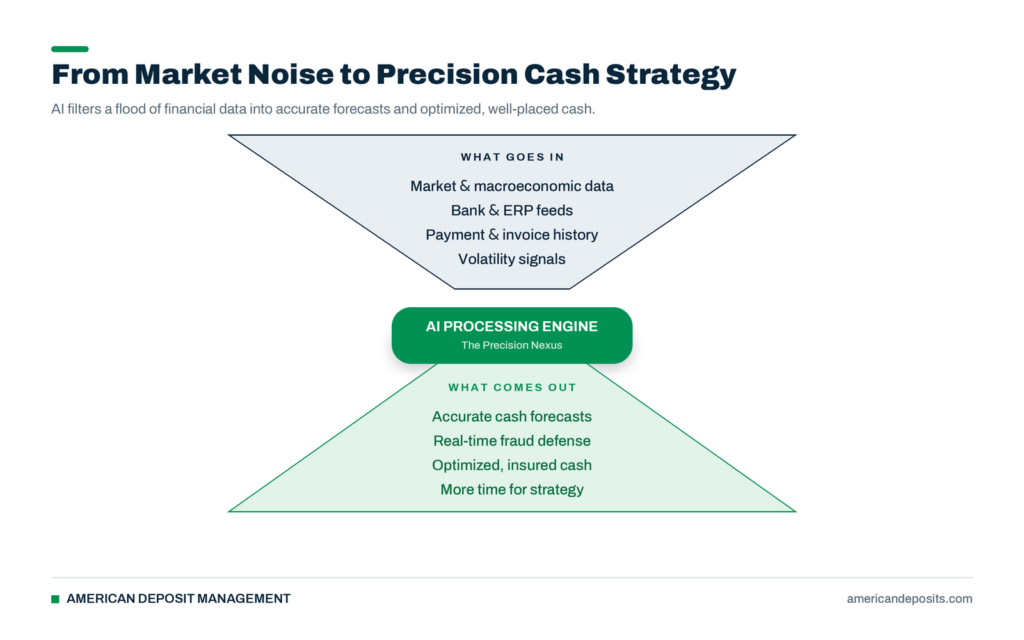
Four capabilities do the work, and they are not interchangeable.
- Machine learning [ML] finds patterns in historical data and sharpens as it sees more.
- Predictive analytics uses those patterns to estimate future outcomes, such as the day an invoice will clear.
- Anomaly detection flags any transaction that breaks a known pattern.
- Generative AI drafts text and summaries, such as a plain-language briefing on the day’s cash position.
Each capability maps to a specific treasury function. The effects are felt across the department – from forecasting to fraud to the back office.
How does AI improve cash forecasting?
The core duty of any treasury department is liquidity – the right amount of cash, in the right place, at the right time, and in the right currency. Forecasting is how treasurers get there, and it is the work they find hardest – as evidenced by a recent study from the Association for Financial Professionals [AFP]. The study found that more than 60% of treasury professionals rank cash and liquidity forecasting as their most challenging task.
Traditional forecasting leans on historical run-rates adjusted for seasonal cycles, but AI works differently. It ingests many data streams at once – enterprise resource planning [ERP] systems, bank telemetry, payables and receivables behavior, and macroeconomic indicators. It then reads subtle patterns in customer payment history to predict when a high-value invoice will actually settle – rather than trusting the stated net-30 terms.
Confidence in that approach is rising fast. The share of practitioners who expect AI to improve cash forecasting climbed from 65% in 2024 to 76% in 2025, per Strategic Treasurer’s AI in Treasury and Finance research and summarized by CTMfile. A sharper forecast lets treasurers act with conviction, deploy surplus cash sooner, and arrange short-term funding before a gap appears.
How does AI keep liquidity optimized and protected?
Idle cash carries a real cost, since money sitting unwatched in a single account earns little and unprotected cash stays exposed. AI changes the picture by giving treasurers a live, consolidated view of cash across every bank and account they hold.
When a surplus builds, the system surfaces it at once. Treasury can then move that cash where it stays both protected and productive. For organizations that hold balances well above the $250,000 FDIC limit, that visibility pairs naturally with a deposit strategy built around extended insurance and competitive yield. The technology spots the opportunity, and a sound cash structure puts it to work safely.
Real-time visibility also sharpens day-to-day control. Treasurers see shortfalls before they bite and direct funds with intent. Then, cash stops drifting and starts working.
How does AI detect and stop payment fraud?
Payment fraud is the clearest case for AI in treasury, because the threat is large and growing. In fact, more than three-quarters of U.S. organizations faced attempted or actual payments fraud in 2025 – according to the 2026 AFP Payments Fraud and Control Survey. Checks remained the most-targeted method at 58%, and business email compromise struck 74% of organizations.
Unfortunately, treasury sits on the front line. Survey respondents named treasury as the department most likely to catch an attempted fraud, at 83%. Yet only 17% of organizations use AI to fight fraud today – a striking gap given the stakes.
Rule-based screening cannot keep pace with adaptive attacks, so AI brings behavioral analysis instead. The model learns the normal cadence, amount, beneficiary, and origin of a company’s outbound payments. It flags an anomalous transaction in real time, before the wire executes.
The same AFP research shows the payoff for teams that adopt it – 49% report more efficient fraud reporting, 45% report better detection of deepfake attempts, and 43% gain real-time identification. Further, the public sector proves the scale.
The U.S. Treasury prevented and recovered over $4 billion in fraud and improper payments in fiscal year 2024, up from $652.7 million the year before. Machine learning aimed at check fraud accounted for $1 billion of that total. Treasury runs this defense across roughly 1.4 billion payments worth nearly $7 trillion a year – and still keeps a person on the final fraud determination.
How does AI clear the back-office backlog?
Cash managers have long suffered the “swivel-chair” effect – moving figures by hand between disconnected bank portals, accounting platforms, and spreadsheets. AI paired with modern application programming interfaces [APIs] now serves as connective tissue. It normalizes data on its own and translates clashing formats from many banks into a single ledger view.
Reconciliation gains the most. AI-powered matching engines apply natural language processing and fuzzy logic to reconcile statements against open invoices, even when a payment description is incomplete, truncated, or full of typos. Confidence here is climbing too, as the share of practitioners who expect AI to ease manual reconciliation rose from 55% to 62% in a single year, per Strategic Treasurer.
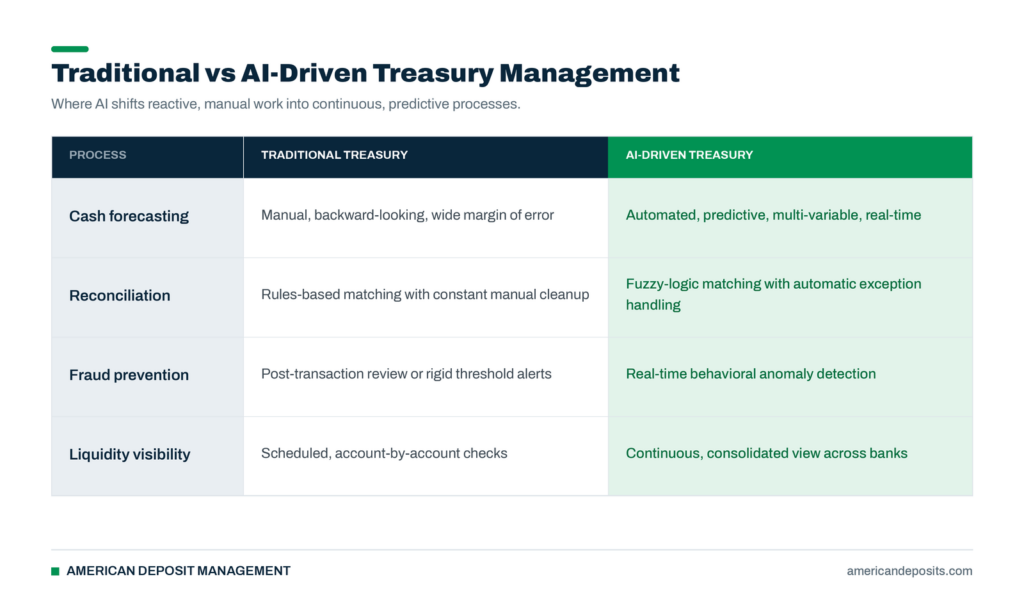
The pattern is clear. AI converts reactive, manual chores into continuous, predictive processes.
What are the real risks of AI in Treasury?
AI in treasury is powerful, but it’s not magic. Three particular risks deserve attention.
First, data quality decides everything. A model is only as good as the data feeding it, and treasury data is often stale or scattered.
When polled by AFP, roughly 59% of treasury teams named data quality and availability – not the technology – as their top barrier to accurate forecasting. The bottom line is, a sophisticated model fed bad inputs still produces a bad forecast.
Second, models need governance. Financial regulators treat model risk seriously, and bank guidance – like the Federal Reserve’s SR 11-7 – sets a high bar for validation and oversight. A treasury team should know how a model reaches its conclusions, test it against reality, and document the controls around it. Generative tools add a further trap – they can state a confident answer that is simply wrong, so no figure should reach a decision unchecked.
Third, autonomy is outrunning oversight. Only about one in five companies has a mature model for governing autonomous AI agents, according to Deloitte’s 2026 State of AI in the Enterprise report. This gap in governance means it’s especially critical to keep a person on every final call.
Where should a treasury team start?
Adoption does not require a moonshot. About 18% of U.S. firms had adopted AI in some form by the end of 2025 – per the Federal Reserve – and the practical path is incremental.
- Fix the data first. Clean, connected, current data is the foundation. Solve this before buying any model.
- Pilot one workflow. Reconciliation or short-term forecasting works well, because both run on data the team already holds and both show results fast.
- Keep a human in the loop. Treat early AI output as a draft that a person reviews, not a verdict.
- Measure, then expand. Track time saved and errors caught. Let proof, not hype, drive the next step.
A focused pilot can turn AI’s potential into results that a treasurer can defend. In fact, two-thirds of organizations already report efficiency and productivity gains from AI according to Deloitte.
The path forward
AI does not replace the judgment needed to steer a company’s finances. However, it can serve as a capable co-pilot. This revolutionary technology clears the administrative friction of forecasting, reconciliation, and fraud monitoring, and that frees treasurers to focus on strategy, banking relationships, and risk.
The advantage will not stay open forever. Most treasury teams have not started, but confidence and capability are both rising rapidly. For cash managers and bankers, the question is no longer whether to adopt AI. The question is how fast they can put it to work – safely, on clean data, with people still in command.
Frequently asked questions
No. AI handles repetitive analysis and pattern-spotting. Treasurers still own strategy, relationships, and the final decision on every flagged payment.
Reconciliation or short-term cash forecasting. Both run on data the team already holds, and both deliver visible results quickly.
It can. Accuracy depends far more on clean, current data than on the model itself. A sophisticated model fed stale data still misses.
It learns the normal pattern of a company’s payments, then flags anything that breaks the pattern – an unusual amount, a new beneficiary, an odd time – before the money moves.
With guardrails, yes. Strong data governance, model validation, and a person on every final decision keep the risk in check.
Subscribe for More Banking History and News from ADM
At American Deposit Management, our team covers the most important historical and emerging perspectives in banking and business cash management. Please take a moment to review our Insights page where you will find all of our past writings, and don’t forget to subscribe to our mailing list to have our weekly article delivered straight to your inbox.
If your company needs access to extended government protection and nationally competitive interest rates, explore our modern cash solutions. With liquid and term accounts, we have the solution you need to capture exceptional yields on reserve cash without sacrificing safety or accessibility.
Contact a member of our team today to learn more about our solutions and get started.
Sources
- Bloomberg, on the Crisil Coalition Greenwich treasury AI survey (February 2026): https://www.bloomberg.com/news/articles/2026-02-26/corporate-treasuries-are-slow-to-adopt-ai-survey-finds
- Association for Financial Professionals, 2026 AFP Payments Fraud and Control Survey: https://www.financialprofessionals.org/about/learn-more/press-releases/Details/over-75-percent-of-us-firms-experienced-payments-fraud-in-2025-while-ai-adoption-for-fraud-mitigation-lags
- U.S. Department of the Treasury, fraud prevention press release (October 2024): https://home.treasury.gov/news/press-releases/jy2650
- Strategic Treasurer, AI in Treasury and Finance research, via CTMfile: https://ctmfile.com/story/treasury-cash-forecasting-rising-expectations-growing-complexity-ais-promise
- Deloitte, 2026 State of AI in the Enterprise: https://www.deloitte.com/us/en/what-we-do/capabilities/applied-artificial-intelligence/content/state-of-ai-in-the-enterprise.html
- Federal Reserve, Monitoring AI Adoption in the U.S. Economy (April 2026): https://www.federalreserve.gov/econres/notes/feds-notes/monitoring-ai-adoption-in-the-u-s-economy-20260403.html
- Association for Financial Professionals (forecasting and benchmarking research): https://www.financialprofessionals.org
How Nonprofits Can Optimize Excess Cash in 2026 – A Guide to Nonprofit Cash Management
In 2026, nonprofit organizations continue to face a difficult financial landscape. Charitable giving has become less predictable for many organizations, operating expenses remain elevated, and…
Banks Are Paying More for Deposits – Why Businesses Should Be Paying Attention
Over the past several years, businesses have become accustomed to a higher interest rate environment. But while many organizations have focused on the Federal Reserve’s…
Deposit Growth Is Slowing. Loan Demand Isn’t. What Bank CFOs Should Do Next
For many financial institutions, the story coming out of Q2 earnings isn’t about credit quality or interest rates, it’s about funding. While loan demand has…
